
Advertisement
The number to watch is 7°C, or 45°F. Michelin’s UK tyre guide says winter tyres are built to drive safely below 7°C whether or not there is snow on the road, because that is roughly where summer rubber starts to go hard. So the honest answer to what temperature should you fit winter tyres is a reading, not a date: when daily temperatures settle at or below 7°C and stay there for a week or so. Nokian gives drivers the same figure in Fahrenheit, telling anyone in an area that consistently drops below 45°F to think about winter rubber.
The short version
Fit winter tyres when the daily average temperature stays at or below 7°C (45°F) for about a week, which in most of northern Europe and the northern United States means late October or early November. Below that point summer compounds stiffen and stop gripping properly. The calendar date is a reminder. The thermometer is the trigger.
What temperature should you fit winter tyres at, and who actually says 7°C?
Two tyre makers, on their own technical pages, land in almost exactly the same place. Michelin’s UK winter tyre page says the hardened rubber that comes with lower temperatures leads to poor grip, and draws the line at 7°C. Nokian Tyres in North America tells drivers to consider winter rubber below 45°F. Michelin’s US site is a degree fussier again and cites 44°F as the point where all-season compounds start to let go.
Be clear about what that number is, though. It is a guideline the industry converged on, not a cliff edge written into the chemistry. Rubber does not flip a switch at seven. Every compound has its own glass transition behaviour, silica loading and oil content, and no tyre maker publishes a single temperature at which its own mix stops working. Treat 7°C as the point where your margin starts shrinking, not the point where the car becomes unsafe.
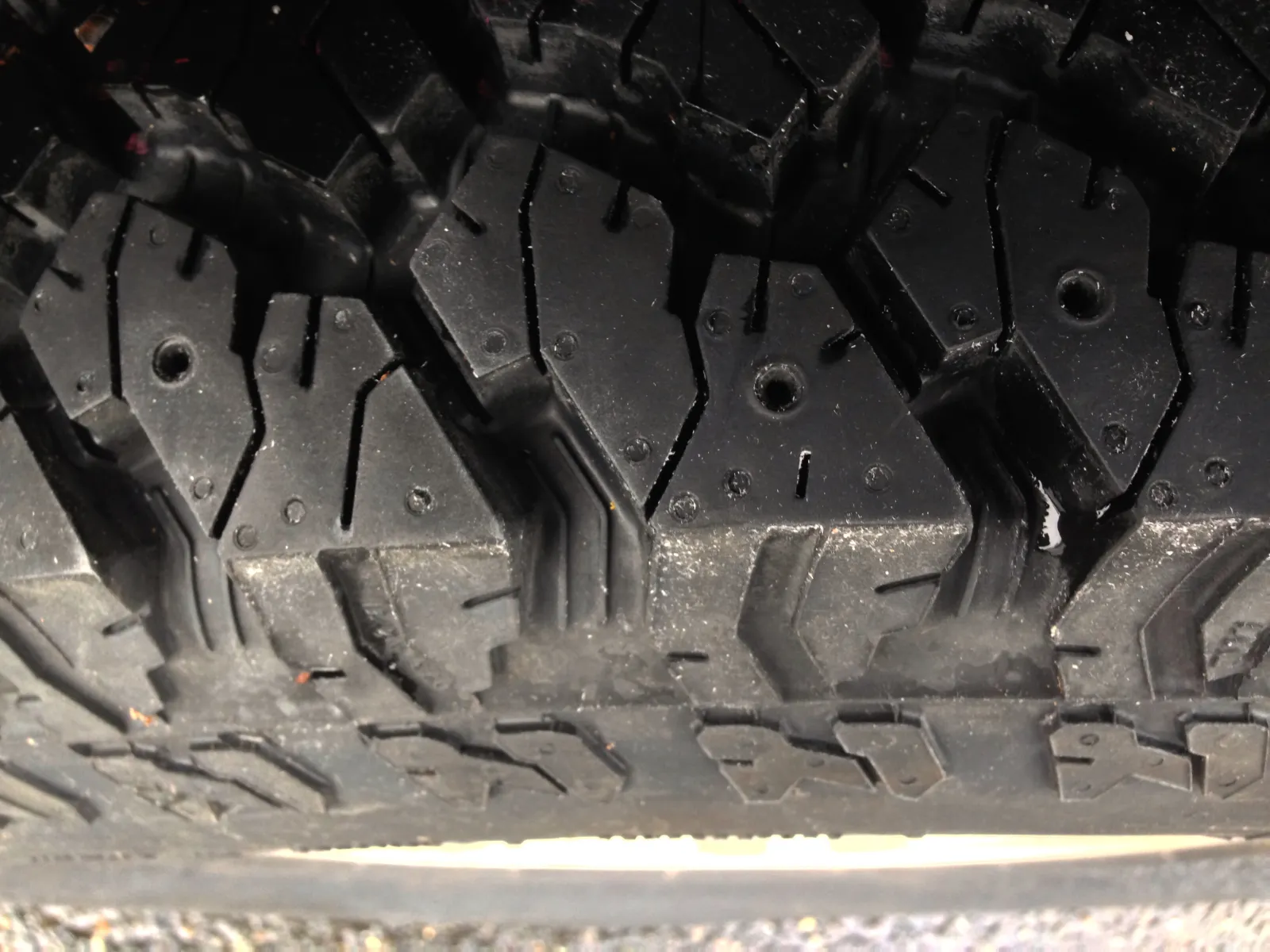
You can feel the difference with a thumbnail. On a frosty morning, press into the tread block of a summer tyre and it pushes back like a pencil eraser. Do the same on a winter tyre and it gives. Michelin puts hard numbers on the design difference too: about ten times more sipes (the fine wavy cuts in each block) and roughly 10% more tread depth than a summer tyre.

Why the calendar is the wrong trigger
Germany has a memorable rule of thumb, “von O bis O”, meaning October to Easter (Ostern). It is easy to remember and legally meaningless. Germany runs a situational winter tyre requirement: the tyres have to match the conditions on the day, not the month on the wall.
Look at what average UK temperatures do and you see why a date fails. October in the UK averages a daily high of 13°C and a low of 6°C. By November that is 9°C and 4°C. An October afternoon is comfortably summer tyre weather. The 7am run to the station on the same day is not. Whoever drives at dawn needs winter tyres weeks before whoever drives at lunchtime, on the same street, in the same car.
The reverse trap catches people in spring. ADAC Nordrhein’s release of 24 March 2026 tells drivers not to trust “O bis O” and to wait until temperatures sit consistently above seven degrees with no more overnight frost.
M plus S on the sidewall is not the same as the snowflake
This is the bit that costs people money. An M+S marking (mud and snow) is self-declared by the manufacturer based on tread pattern. Continental’s own tyre knowledge page puts it bluntly: the performance of M+S marked tyres “is therefore neither defined nor measured”. Nobody tested it. The maker looked at the mould and stamped the sidewall.
The three-peak mountain snowflake, or 3PMSF, is measured. In the United States, NHTSA’s rule of 8 June 2022 rewrote the definition in FMVSS No. 139 so that a snow tyre is one that reaches a traction index of at least 112 against the ASTM F2493 standard reference test tyre, on a medium-pack snow surface, tested to ASTM F1805-20, and carries the alpine symbol on at least one sidewall. Continental confirms the same ASTM F1805 test underpins the European marking.
Practical version: crouch down, find the little mountain outline with a snowflake inside it, and ignore whatever else is stamped nearby. Several countries no longer count an M+S-only tyre as winter equipment.
Where the law takes the decision away from you
If you drive into any of these places in winter, the thermometer stops being the deciding factor.
| Where | Period | What counts | Tread and penalty |
|---|---|---|---|
| Quebec | 1 December to 15 March | Snowflake pictogram or studs | 1.6 mm legal, 4.8 mm advised. Fine CAD 200 to 300 |
| Germany | Whenever roads are wintry | Alpine symbol only since 1 Oct 2024 | 1.6 mm legal. Fine 60 to 120 euros for the driver |
| France (Loi Montagne) | 1 November to 31 March, 34 departements | 3PMSF, or chains in the boot | 135 euro fixed fine quoted by Continental France |
| Austria | 1 November to 15 April, when needed | Winter tyres or chains | 4 mm minimum on radials |
| Sweden | 1 December to 31 March | Winter tyres, studs optional | 3 mm minimum |
| Finland | 1 November to 31 March, when needed | Winter tyres | 3 mm minimum under 3.5 t |
| United Kingdom | No requirement | Anything road legal | 1.6 mm year round |
Quebec also fixes the studded tyre window at 15 October to 1 May for cars and commercial vehicles under 3,000 kg. France’s penalty is messier than the table suggests: Continental France states a 135 euro fixed fine, while French motoring press has pointed out for years that the original 2020 decree set no specific sanction, so non-compliance in practice means being turned back.
Are all season tyres good enough in winter?
Sometimes, and less often than the marketing suggests. ADAC published its 2026 all-season test on 23 June 2026, running 16 tyres in 185/65 R15, the size small hatchbacks wear. Exactly one, the Continental AllSeasonContact 2, scored “good” at 2.3. Eight got no purchase recommendation and five were rated deficient on safety grounds.
ADAC’s own conclusion is the sensible one: all season tyres suit occasional drivers, while high mileage or real heat and real winter call for two dedicated sets. Having run CrossClimates through three English winters, I think a 3PMSF all-season is the right call where you get four cold wet months and one snowy week. Where the gritters are out twice a week, it is a compromise you feel in the first 20 metres of a downhill junction.
What mid-September 2026 means for your timing
All of the above was checked on 16 September 2026. In the northern hemisphere that leaves roughly six weeks of slack. Nothing needs doing this week, but the workshop diary does. Every year the first hard frost sets off a stampede, and the garage that would have fitted you in on a Tuesday in early October suddenly quotes eleven days.
Budget honestly. Honest John’s 2026 running costs guide puts a decent winter tyre at around £125 a corner on a 16-inch wheel, about £250 if your SUV rides on 21s. North American shops charge roughly $90 to $250 a season to store the set you are not running. Two sets wear across twice the distance, so the rubber cost is close to a wash over three or four years. Fitting, balancing and storage is the genuinely extra bit.
Book the swap for the last week of October. While the car is on the ramps, have the 12V battery tested, because cold mornings are when a tired one gives up, and EV owners get caught out most (see why the 12-volt battery in an EV keeps dying). It is a free moment to ask about open recalls too, the way owners have over the Jeep Grand Cherokee rear coil spring recall.
Southern hemisphere readers can invert everything here. Your 7°C window opens in May.
FAQ
How long do winter tyres last?
Two limits apply, and the first one to arrive wins. Continental says a winter tyre loses much of its snow traction below 4 mm of remaining tread and should be replaced at that depth at the latest, not at the 1.6 mm legal minimum. ADAC separately advises replacing tyres at about six years old because the compound hardens with age. At average mileage split across two sets, that usually works out at four to six winters.
Do I need winter tyres on an EV?
If you regularly see temperatures below 44°F, Michelin says yes, and its reasoning is EV-specific. Battery packs make the car heavier, so the braking advantage of a winter tyre matters proportionally more, and instant motor torque will happily spin a wheel on ice. Match the load rating on your door jamb sticker: if the car calls for XL or HL, the winter tyre must be XL or HL too. Expect a small extra hit to winter range on top of the usual cold weather loss.
When should I change back to summer tyres?
ADAC Nordrhein’s guidance from March 2026 is to wait until temperatures sit consistently above seven degrees Celsius and overnight frost has stopped for good, rather than swapping at Easter out of habit. In the UK that is usually mid to late April. Leaving winter tyres on through a hot summer is legal almost everywhere, but the soft compound wears fast and lengthens dry braking distances.
Do I have to fit all four, or just the driven axle?
All four, always. Two winter tyres on the front of a front-wheel-drive car give you grip to pull away and grip to steer, while the rear axle keeps the hard summer compound. The result on a cold roundabout is a car that rotates on you. Every manufacturer and regulator agrees on this one.
About this article: temperature guidance was checked on 16 September 2026 against Michelin UK and Michelin USA, Nokian Tyres North America and ADAC. The 3PMSF certification details were checked against Continental’s tyre knowledge pages and NHTSA’s FMVSS No. 139 amendment published in the Federal Register on 8 June 2022. Legal requirements were checked against the Gouvernement du Quebec, the European Consumer Centre Germany and Continental France. All season test data comes from ADAC’s all-season tyre test released on 23 June 2026. Winter tyre range effects on EVs are covered separately in how much range an EV loses in winter.
2 thoughts on “What Temperature Should You Fit Winter Tyres? 2026 Guide”